
A corporate debt market enables private industry to raise funds through debt instruments and channelise these into specific sectors, including infrastructure.

Among possible new members, former chief economic advisor Arvind Virmani's name is doing the rounds.

'Similar to the case of the digital payment system where the government created a public platform and others joined in, we are exploring a similar structure to create a PPP platform where the compute required for AI could be accessed by the small player.'

'The shifts in US involvement in global conflicts and geopolitical alliances could introduce uncertainties.'
The government had projected the GDP growth to be at 8.5%.

'Sweden removed the inheritance tax because many of the rich were fleeing. For example, the owner of IKEA had migrated out of Sweden'

Finance Minister Nirmala Sitharaman on Thursday announced a Rs 11.11 lakh crore spending on infrastructure and vowed to continue reforms as she resisted resorting to populist measures in Modi government's last Budget before general elections, instead choosing to stay on the path of cutting deficit while bolstering measures for focus groups.

'Tensions and dialogue are likely to go hand-in-hand with China.' 'The goal should be to cultivate power so that one can negotiate from a position of strength.'

Modi said today "we all have reached an important and historic partnership".

Following are comments from economists at leading financial institutions, banks and rating agencies on the interim Budget:

The average age of an Indian by 2020 would be 29 years as compared to 29 years in case of China and 48 for Japan.

Making it clear that development of rural areas and uplift of social classes would be crucial to building the 'India of tomorrow', he said his government had taken a series of initiatives aimed at investing in rural and urban infrastructure, generating maximum employment and improving productivity of farm economy.

Analysts and economists have hailed the fiscal projections in the interim Budget, saying the lower fiscal deficit forecast shows that the government, even in an election year, is serious about fiscal consolidation and that the numbers look achievable. According to Devendra Kumar Pant, the chief economist at India Ratings, the two broad themes of the interim Budget are fiscal consolidation and stepping up focus on agriculture/rural to course correct, to some extent, the differential benefits of the ongoing economic growth that's tilted in favour of upper-income bracket/urban households. The projected fiscal deficit numbers for FY24 and FY25 suggest that the government is serious about achieving the fiscal consolidation path of 4.5 per cent fiscal deficit by FY26, and given the nominal GDP growth assumption and revenue buoyancy, the target appears plausible, Pant said in a note.
'The intensity and frequency of heatwaves will be much higher than in previous years over Punjab, Haryana, Rajasthan, Gujarat, Madhya Pradesh and Odisha.'

'Adventure travel, cultural tours, and wellness retreats are in high demand.'
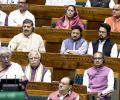
Finance Minister Nirmala Sitharaman on Tuesday announced income tax relief for the middle class, a Rs 2 lakh crore outlay for job creation schemes over the next five years and a spending splurge for states run by her party's new coalition partners as she unveiled the Modi 3.0 government's first budget after the general elections.

The World Bank has retained India's economic growth forecast for the current fiscal at 8.3 per cent as the recovery is yet to become broad-based. As per the first advanced estimates of the national income released by the National Statistical Office (NSO) last week, the economy is projected to grow at 9.2 per cent in 2021-22, surpassing pre-COVID level in actual terms, mainly on account of improved performance, especially in farm, mining and manufacturing sectors. "India's economy is expected to expand by 8.3 per cent in fiscal year 2021/22 (ending March 2022), unchanged from last June's forecast as the recovery is yet to become broad-based.

Monetary tightening to contain overheating as well as inadequate infrastructure is likely to slow down India's growth to moderate 8 per cent next fiscal against the expected 9.2 per cent, the Asian Development Bank has forecast.

Uttar Pradesh Chief Minister Yogi Adityanath defended the Maha Kumbh, claiming it generated Rs 3 lakh crore in business and provided significant economic benefits to the region. He also highlighted the "flawless" law-and-order management during the event, citing no crime reports despite the participation of 66 crore devotees and tourists. Adityanath countered opposition criticism of the event, stating that a family with 130 boats made a profit of Rs 30 crore during the 45-day congregation.

Gadkari said that the MSME sector contributes significantly in pushing the country's economic growth and creating employment.

This will be the first full-year Budget of the BJP-led National Democratic Alliance government since it came to power for a third consecutive term in July last year.

Industry experts on Friday called upon the new BJP-led NDA government to focus on attracting investments in key sectors, especially the infra space, to revive growth and investor confidence.

Finance Minister Nirmala Sitharaman on Saturday announced six new schemes and increased the subsidised Kisan Credit Card (KCC) loan limit to Rs 7 lakh from Rs 5 lakh, targeting everything from unemployment to crop productivity enhancement across the country. Presenting her eighth budget speech in Parliament, Sitharaman positioned agriculture as "the first engine of growth" and unveiled the Prime Minister Dhan-Dhaanya Krishi Yojana, a flagship program targeting 100 agri-districts grappling with low productivity, moderate crop intensity, and below-average credit parameters.
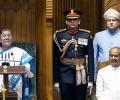
President Droupadi Murmu addressed both Houses of Parliament, highlighting the government's achievements in various sectors, including economic growth, social welfare, and infrastructure development. She emphasized the government's efforts to lift the economy out of "policy paralysis" and create a more inclusive society. Murmu also acknowledged the challenges posed by digital fraud and cybercrime and stressed the need for a social infrastructure revolution. The President's speech is considered a policy statement, outlining the government's vision and roadmap for the future.


India's economic growth is gaining momentum, Paris-based think tank OECD said on Monday amid the new government initiating various measures to bolster the economy.

ADB projected China's growth to decelerate from 7.4 per cent

Shifting to a PPP model could repeat the errors of the past

The Bharatiya Janata Party and its allies on Tuesday welcomed the Union Budget and said it focussed on youth, farmers, women, and has 'substantial allocations' for Maharashtra, but the opposition slammed the annual financial statement, claiming it neglected the western state and only seeks to please the saffron outfit's partners in Bihar and Andhra Pradesh.
In a bid to propel the hospitality industry to contribute to the country's economic growth, Hotel Association of India has asked the government to rationalise tax structure and grant 'infrastructure industry' status to hotels

Anticipating US action on tariffs, India seems to have made the first move by revamping its tariff structure by reducing the slabs to eight rates, points out Mukesh Butani.

Echoing Prime Minister Narendra Modi's views that improving the health of financial markets alone cannot fuel growth, G20 business leaders on Friday said vigorous efforts should be made to go beyond fiscal and monetary policy to kickstart world economy and create jobs.

While Andhra Pradesh is expected to receive Rs 15,000 crore to Rs 20,000 crore, Bihar is likely to get Rs 5,000 crore to Rs 10,000 crore in FY25.

Growing at a robust rate due to economic reforms in key sectors like digitisation and infrastructure, India has emerged as a star performer and is projected to contribute more than 16 per cent of the global growth, the International Monetary Fund said on Monday. "What we have been observing for quite some time now is that India has been growing at a very robust rate. "It's one of the star performers when it comes to real growth when you look at peer countries.

Sources said a 100-day agenda for immediate steps to be taken after a new government is formed in May was deliberated upon during the meeting for its quick implementation.

Microsoft chairman and CEO Satya Nadella on Wednesday highlighted the importance of driving inclusivity and empowerment through technology and economic growth and asserted that the company is "very committed to India". He was speaking at Microsoft's Tech for Good and Education showcase, an event that highlighted the impact created by technology in the areas of philanthropic work and education. Nadella did a walk through, interacting with teachers, students and professionals who are making a difference in the society, by leveraging various Microsoft programs, initiatives and tools.

'I am optimistic about the Budget because of the fiscal discipline the government has committed to.'

'Peninsular Indians could ask 'Why should we contribute half of India's tax revenues if we account for only a quarter of the seats in the Lok Sabha?'.' 'The rest of the country seems likely to counter that 'democracy means one vote per person irrespective of where that person resides in India'.' 'With no easy answers to this thorny debate, the south's economic ascendancy could end up creating a Hobson's choice.' A revealing excerpt from Nandita Rajhansa and Saurabh Mukherjea's book, Behold the Leviathan: The Unusual Rise of Modern India.
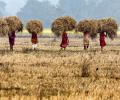
In a significant policy shift aimed at boosting agri-productivity and rural prosperity, Finance Minister Nirmala Sitharaman on Saturday announced six new agricultural schemes while increasing the subsidised Kisan Credit Card loan limit to Rs 5 lakh from the existing Rs 3 lakh, benefiting 7.7 crore farmers, fishermen, and dairy farmers.
